

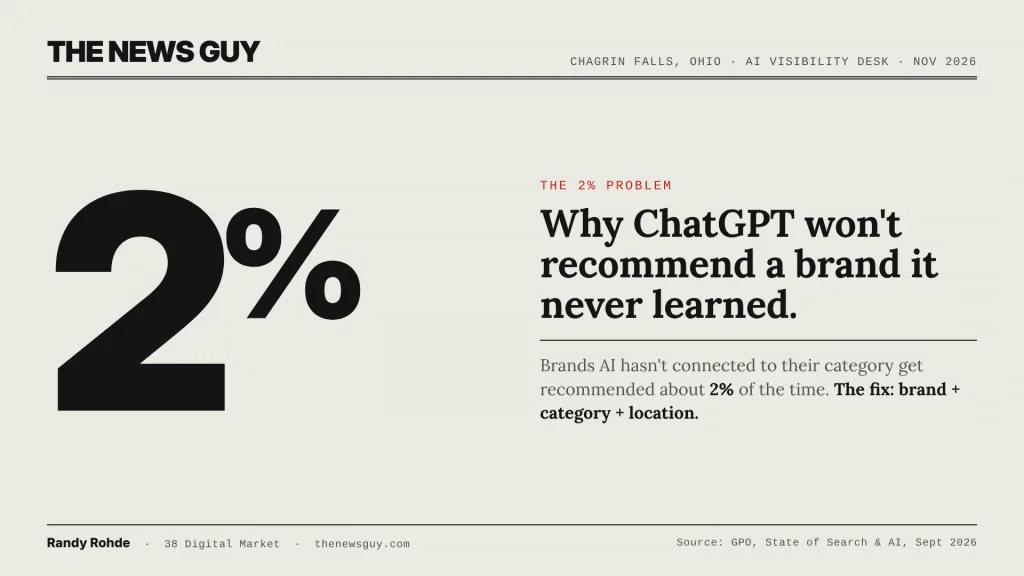
Short answer: ChatGPT often decides which brands to recommend before it searches, based on associations it already holds between brands and categories. In testing cited by GPO’s September 2026 State of Search & AI report, brands without that connection were recommended only about 2% of the time. The fix is to teach the association on purpose: state your brand, category, and location together in every press release, distribute it to recognized news sites, and repeat every month.
By Randy Rohde, founder of The News Guy and 38 Digital Market, Chagrin Falls, Ohio
Key takeaways
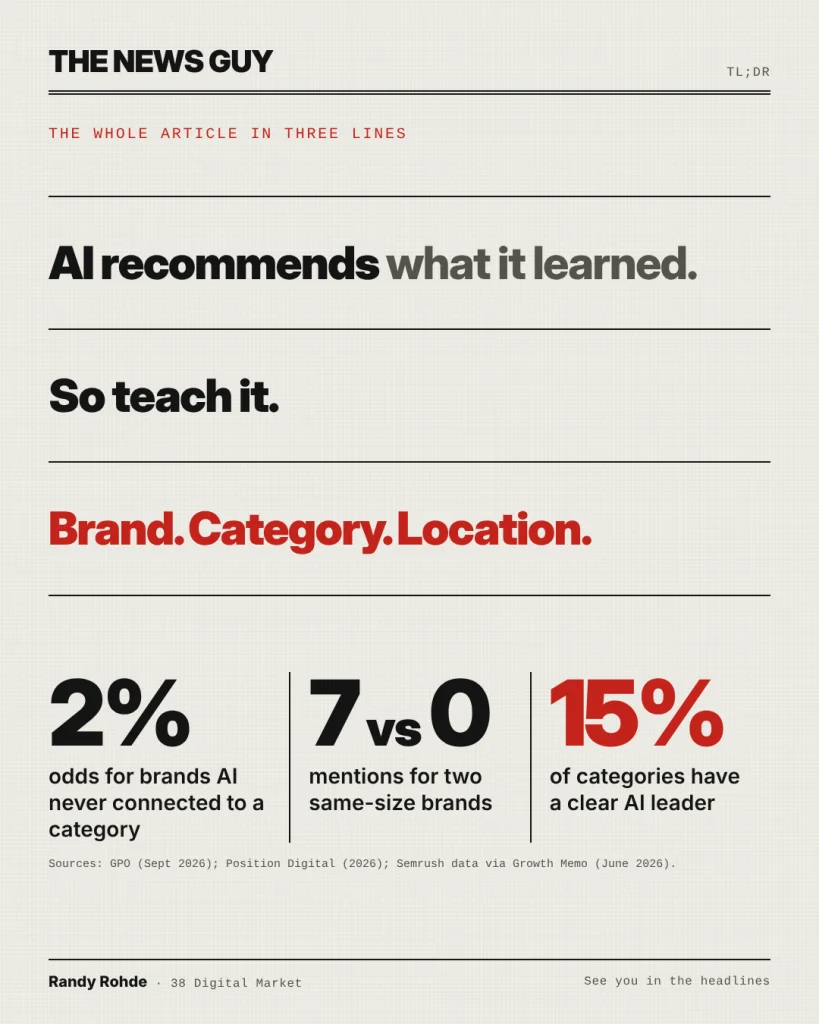
- Brands ChatGPT hadn’t already connected to their category were recommended about 2% of the time.
- Two software brands with nearly identical websites got 7 mentions and 0 mentions. The difference was how often each appeared in “best of” roundups.
- 66% of ChatGPT brand recommendations happened without citing the brand’s own website.
- Only 15.2% of 1,094 categories had a clear brand owner in ChatGPT, and owners held first place 90.4% of the time.
- The formula: brand + category + location, near the top of every press release, every month.
What is the 2% problem in ChatGPT?
What is the 2% problem in ChatGPT?
If ChatGPT doesn’t connect your brand to your category, your odds of being recommended are about 2%. Two. Roughly the number of people who read the terms of service.
The figure comes from an analysis by search consultant Suganthan Mohanadasan, summarized in GPO’s September 2026 State of Search & AI report. He captured the search queries ChatGPT writes behind the scenes when a user asks for recommendations. Brands that ChatGPT named in its own queries appeared in 68.9% of final answers. Brands it retrieved but never named appeared in just 2.1%, a gap of roughly 33 times.
The sample was small: 60 conversations from a single ChatGPT Plus account, captured in July 2026, and weighted toward software. Treat the exact number as directional. The pattern is the useful part. In 21 of 27 first queries, ChatGPT added brand names the user never typed. The model often has a shortlist in mind before it reads a single web page.
It’s like a hiring manager who has already picked the candidate and is interviewing you to be polite.
Why does ChatGPT pick brands before it searches?
ChatGPT doesn’t know your business the way your customers do. It learns patterns: which names keep showing up next to which topics, across the sources it trusts. When it reads “commercial roofing” next to your brand name over and over, it starts to connect the two. When it never sees them together, you’re not on the guest list.
For broad “what’s the best brand for X” questions, GPO’s report notes that the model leans heavily on associations formed during training rather than on live web retrieval alone. Live search still matters, but it mostly confirms and fills in a shortlist the model already has.
What separates brands ChatGPT recommends from brands it ignores?
Not size. Association. Position Digital’s 2026 study of ChatGPT ranking factors compared Hive and Imagga, two B2B software companies in the same niche with near-identical web footprints (about 4,700 and 4,300 pages). Hive appeared in 25% of its category’s “best of” listicles and was named by ChatGPT seven times. Imagga appeared in 2% of those listicles and was named zero times.
Same size. Same internet. Different association.
The same study found that 66% of ChatGPT’s brand recommendations happened without ChatGPT citing the recommended brand’s own website. The recommendation was built on what other sites said about the brand. Your website is your opinion of you. The internet’s opinion of you is what gets you recommended.
What does the research say about ChatGPT brand recommendations?
Finding | Source |
Brands named in ChatGPT’s own search queries reached 68.9% of final answers. Brands retrieved but never named reached 2.1%. | Suganthan Mohanadasan, July 2026 (60 conversations), cited by GPO |
A brand in 25% of category listicles got 7 ChatGPT mentions. A same-size brand in 2% got 0. | Position Digital, 278 prompts across 6 B2B SaaS niches |
66% of brand recommendations didn’t cite the brand’s own website. | Position Digital |
15.2% of 1,094 U.S. categories had a clear brand owner. 53.7% had no consistent leader. | Semrush data, Growth Memo, June 2026 |
Category owners kept first place in 90.4% of month-over-month comparisons. | Semrush data, Growth Memo |
Branded search volume was the only conventional SEO metric that consistently tracked with category ownership. | Semrush, via MarTech |
That last finding is worth a second look. Domain authority and backlinks didn’t predict which brand owned a category. How often people searched for the brand by name did. Being known is the signal, and a steady stream of news coverage is one of the most direct ways to get known.
How do you teach ChatGPT to associate your brand with your category?
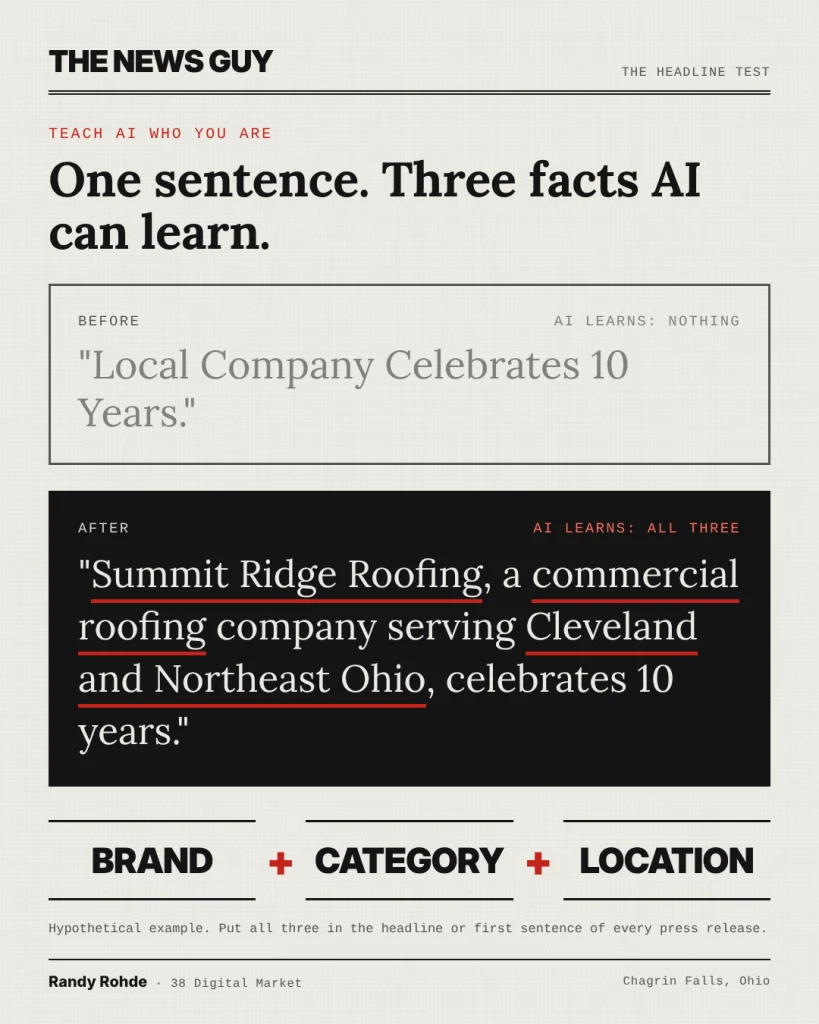
With a formula so simple it’s almost insulting: brand + category + location. Every press release you publish should state all three, clearly and close together. Who you are. What you do. Where you do it.
Here is a before-and-after, using a hypothetical roofing company:
- Before: “Local Company Celebrates 10 Years.” Lovely. Means nothing. To an AI, it’s a birthday card with no name on it.
- After: “Summit Ridge Roofing, a commercial roofing company serving Cleveland and Northeast Ohio, celebrates 10 years.” Three facts. One sentence. A lesson the AI can actually learn.
This is what I mean when I say press releases are prompt engineering. You’re writing the study notes before the AI takes the test. When the release is distributed to recognized news sites, those study notes live in exactly the places AI systems trust.
Ready to get Started?
Why does one press release not fix the 2% problem?
One press release is a nice Tuesday. It isn’t a strategy. Association comes from repetition: the same brand name, the same category words, the same location, over and over, across months.
The timing is in your favor. Kevin Indig’s Growth Memo analysis of Semrush data tracked 1,094 U.S. categories in ChatGPT from January through June 2026. Only 15.2% had a clear owner. The other 85% were either contested by an emerging leader or wide open. And once a brand owned a category, it kept first place in 90.4% of month-over-month checks. Once AI decides you’re “the roofing company,” it tends to stick.
The window is open right now. It won’t stay open forever.
How can you fix your 2% problem in five steps?
- Ask ChatGPT what your customers ask. Try “best commercial roofer in Cleveland” or the equivalent for your business. See who shows up. If it isn’t you, now you know.
- Pick your exact words. One brand name, spelled the same way every time. One category phrase. One location. Write them down. Tattoo them somewhere tasteful.
- Put that phrase near the top of every press release. The headline or the first sentence.
- Distribute to recognized news sites. The association needs to live where AI looks for trusted sources.
- Keep a rhythm. Monthly is a great start. New hire, new project, new milestone, same three facts. Then go back to step one each month and check your progress.
AI recommends what it learned. So teach it. Brand. Category. Location. Every time.
Frequently asked questions
Why doesn’t ChatGPT recommend my business?
The most common reason is that ChatGPT hasn’t connected your brand to your category. For “best brand for X” questions, it relies heavily on associations it already holds. Testing cited in GPO’s September 2026 State of Search & AI report found brands without that association were recommended about 2% of the time.
How does ChatGPT decide which brands to recommend?
ChatGPT learns which brand names repeatedly appear next to which topics across sources it trusts, such as news articles, reviews, and “best of” roundups. It often names candidate brands in its own search queries before reading any results, then builds its answer largely around those brands.
Does my website help me get recommended by ChatGPT?
It helps, but less than most owners expect. In a 2026 Position Digital study, 66% of ChatGPT brand recommendations happened without ChatGPT citing the recommended brand’s own website. Third-party coverage of your business carries more weight.
How do press releases help a brand get recommended by AI?
A press release distributed to recognized news sites places your brand name, category, and location together in sources AI systems trust. Repeated across months, those releases build the brand-to-category association that AI tools draw on when they recommend businesses.
What is the brand, category, and location formula?
It is a simple rule from Randy Rohde of The News Guy: state your exact brand name, what you do, and where you do it, close together near the top of every press release. Example: Summit Ridge Roofing, commercial roofing, Cleveland and Northeast Ohio.
How often should a business publish press releases for AI visibility?
Monthly is a strong starting point. Association comes from repetition, so a steady cadence of releases about hires, projects, partnerships, and milestones, each repeating the same brand, category, and location, works better than a single announcement.
Find out whether ChatGPT knows your brand
Want the full playbook? Download the free eBook, How To Get Your Brand Featured in AI Overviews. Unlike the terms of service, you’ll actually want to read this one.
Or book a free 15-minute press release consultation. We’ll ask the AI about you together and see whether it connects your brand to your category.
About the author
Randy Rohde is the founder and CEO of 38 Digital Market and The News Guy, a press release distribution and AI visibility firm based in Chagrin Falls, Ohio. A nationally recognized PR expert with a journalism background, Randy helps businesses use press releases for Answer Engine Optimization (AEO), so AI tools and search engines describe them accurately. He hosts the Hot Off The Press podcast and a weekly YouTube series, and serves on the board of the Chagrin Valley Chamber of Commerce. Connect with Randy on LinkedIn or YouTube.
Sources
- GPO, “September 2026 State of Search & AI”.
- Suganthan Mohanadasan analysis, reported by PPC Land, “Brands named in ChatGPT’s own query win mentions 33x more often” (August 2026).
- Position Digital, “Top ChatGPT Ranking Factors in B2B SaaS” (updated August 2026).
- Kevin Indig, Growth Memo, “Does Topical Authority Matter in AI Search?” (July 2026), using Semrush AI Visibility Toolkit data.
- MarTech, “ChatGPT has no clear brand leader in most categories” (July 2026).
Ready to get Started?
