

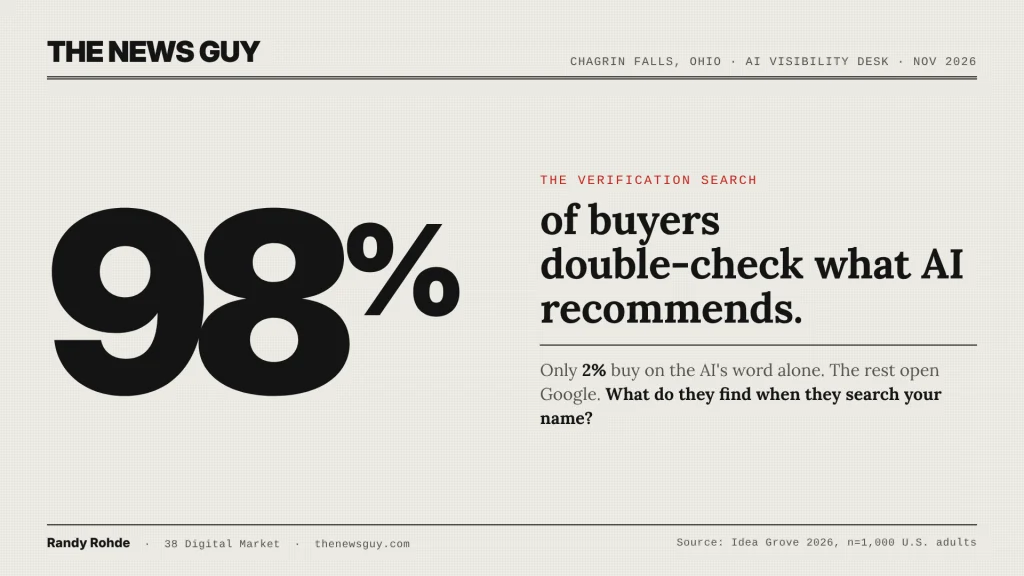
Short answer: they go check. According to an April 2026 Idea Grove survey of 1,000 U.S. consumers, only 2% would buy from an unfamiliar brand based on an AI recommendation alone. The other 98% verify first, and 45% go straight to Google to search the brand’s name. Getting recommended by ChatGPT puts you on the shortlist. What buyers find in that second search decides whether you get the sale.
By Randy Rohde, founder of The News Guy and 38 Digital Market, Chagrin Falls, Ohio
Key takeaways
- Only 2% of consumers buy from an unfamiliar AI-recommended brand without researching it first.
- 45% Google the brand immediately, and 18% go straight to review sites.
- Only 15% believe AI recommendations are generally the best options available.
- Reviews (78%), search rankings (71%), business longevity (69%), and press coverage (58%) are the top trust signals.
- 69% of consumers would choose a brand with press coverage over one without.
- A distributed press release helps in both places: it feeds AI tools accurate facts and puts news headlines on page one of Google.
Hey, getting recommended by ChatGPT is step one. Congratulations. Hey, pop the cheap champagne. Step two, the customer opens Google to see if you're real. What do they find? Because if the answer is a dusty Facebook page from 2019 and one review from your mom, well, hey, we need to talk. Hey, I'm the news guy and today we'll explore the step after the AI recommendation that almost nobody is planning for, and how one press release covers both. Ready to make headlines? Idea Grove just surveyed 1,000 US consumers about what happens after an AI tool recommends a brand they've never heard of. Only 2% would buy on the AI's word alone. Just 2%. That's not a customer base. That's a rounding error with a credit card. The other 98% go check, and honestly, good for them. Only 15% fully trust AI recommendations. Everyone else is giving ChatGPT the same look you give a guy selling Rolodexes out of a trench coat. So here's the shift. AI doesn't close the sale. It gets you on the short list. What closes the sale is what happens next. And where do they check? 45% go straight to Google and search your name. Another 18% head right to the review sites. Think about that. The robot recommends you and the human immediately asks the other robot, hey, is this guy legit? It's a background check and you're the one being checked. This is the handoff nobody's planning for. SEOs are obsessing over AI citations. Business owners are asking, how do I get into ChatGPT? Hey, and those are great questions, but the deal lives or dies in that second search. So let's play, what do they find? Door number one, ghost town. A website, a Facebook page that hasn't posted since the pandemic, and that's it. The customer's thinking, is this place even open? The deal is dead. Hey, and door number two, the mixed bag. Some reviews, a listing with an old phone number, and your competitor's ad sitting right on top of your own name. Rude. Door number three, the headliner. Website, good reviews, and real news coverage with your name in the headline. Guess which one gets the call? The data agrees with your gut. 58% of consumers say press coverage in recognized publications increases their trust. And when people had to pick between a brand with media coverage and one without, 69% picked the one with coverage. And here's why I love this data. A press release doesn't win once, it wins twice. Win number one is in the AI answer. AI tools learn about brands from what's published about them across the net. A well built press release distributed to real news sites gives the AI clear consistent facts about who you are and what you do. That's why I call press releases prompt engineering. You're writing the notes that AI studies before the test. When number two, in the verification search. When that customer Googles you, those same news articles show up on page one. Now they're not seeing a ghost town. They're seeing headlines. One asset, two jobs. It's like a mullet. Business in the AI answer and party on page one. And fun fact, nearly half of consumers, 48%, don't even realize brands try to influence AI recommendations. Your competitors probably don't either. That's your head start. So how do you become door number three? Well, you can do it in four moves. First, Google yourself today. Brand name, your name, brand plus reviews. See what the 45% see, and you better bring a stress ball. Step two, give the press something real. A launch, a milestone, a hire, a local partnership, an award. Turn it into a press release that states clearly who you are, what you do, and where you do it. Step three, distribute it to recognized news sites. So it lands where both the AI and Google are looking for. And step four, back it up. Reviews a current website, a founder profile, press coverage opens the door. Reviews keep it from slamming on your foot, then repeat. One releases a headline, a steady stream, that's reputation. Hey, if you want the full playbook, grab my free ebook, how to get your brand featured in AI overviews. The link is in the description below. It's free. I checked twice like 90% of people would. And if you'd rather just ask me what Google and ChatGPT are saying about your brand right now, hey, book a free consultation with me. The link to my calendar is in the description below as well. Bring your questions and I'll bring the coffee. Well, virtually, of course. AI gets you on the list. Google gets you the deal. The press gets you both. Hey. Now if you'll excuse me, I'm gonna go Google myself. Well, hey, purely for research, of course. Like, follow, subscribe, and I'll see you in the headlines.
What happens after an AI tool recommends your business?
Here is the part most AI visibility advice skips. Getting mentioned in ChatGPT, Gemini, or Google’s AI Overviews is step one. Step two is the customer opening a new tab to see whether you’re real.
The Idea Grove 2026 Study, How Consumers Verify AI-Recommended Brands, surveyed 1,000 U.S. adults through Pollfish in April 2026. It asked a simple question: when an AI tool recommends a brand you’ve never heard of, what do you do next? Ninety-eight percent take some other step before buying. Only 2% take the AI’s word for it.
That 2% isn’t a customer base. It’s a rounding error with a credit card. For everyone else, the AI recommendation starts a background check, and your business is the one being checked.
AI use for shopping research is already mainstream. The same study found that 42% of Americans used ChatGPT to research a product, service, or brand in the past six months, and 38% used Google Gemini. Among Gen Z, ChatGPT use for brand research reached 67%, compared with 30% of baby boomers. The heaviest AI users still double-check, though. Zero percent of Gen Z respondents said they would buy without further research.
How much do consumers trust AI recommendations?
Not much. Only 15% of consumers believe AI recommendations are generally the best options available. The rest fall into three groups:
- 40% are pragmatic skeptics. They use AI tools but don’t fully trust the output.
- 27% are actively skeptical. They suspect AI may favor brands that have figured out how to game the system.
- 19% don’t trust AI recommendations at all.
There is also an awareness gap. Nearly half of consumers (48%) don’t realize companies actively try to influence AI recommendations, and 40% didn’t know AI tools can recommend different brands when asked the same question at different times. In practice, most of your competitors don’t know this either. That’s your head start.
Where do buyers go to verify an AI-recommended brand?
Google, by a wide margin. Here is the first step consumers say they take after an AI tool recommends a brand they don’t know:
First step after an AI recommendation | Share of consumers |
Search the brand on Google | 45% |
Go directly to review sites | 18% |
Visit the brand’s website | 16% |
Ignore the recommendation | 10% |
Ask someone they know | 9% |
Buy without further research | 2% |
Source: Idea Grove, 2026 Study: How Consumers Verify AI-Recommended Brands (n=1,000 U.S. adults).
The robot recommends you, and the human immediately asks the other robot whether you’re legit. If your brand-name search results are thin, outdated, or crowded by a competitor’s ad, the AI recommendation you worked to earn goes to waste.
What signals convince buyers to trust an AI-recommended brand?
The same signals that built trust before AI existed. When Idea Grove asked what increases confidence enough to buy, consumers ranked:
- Verified customer reviews with a high average rating (78%)
- Google search rankings (71%)
- How long the business has existed (69%)
- A polished, professional website (64%)
- Press coverage in recognized publications (58%)
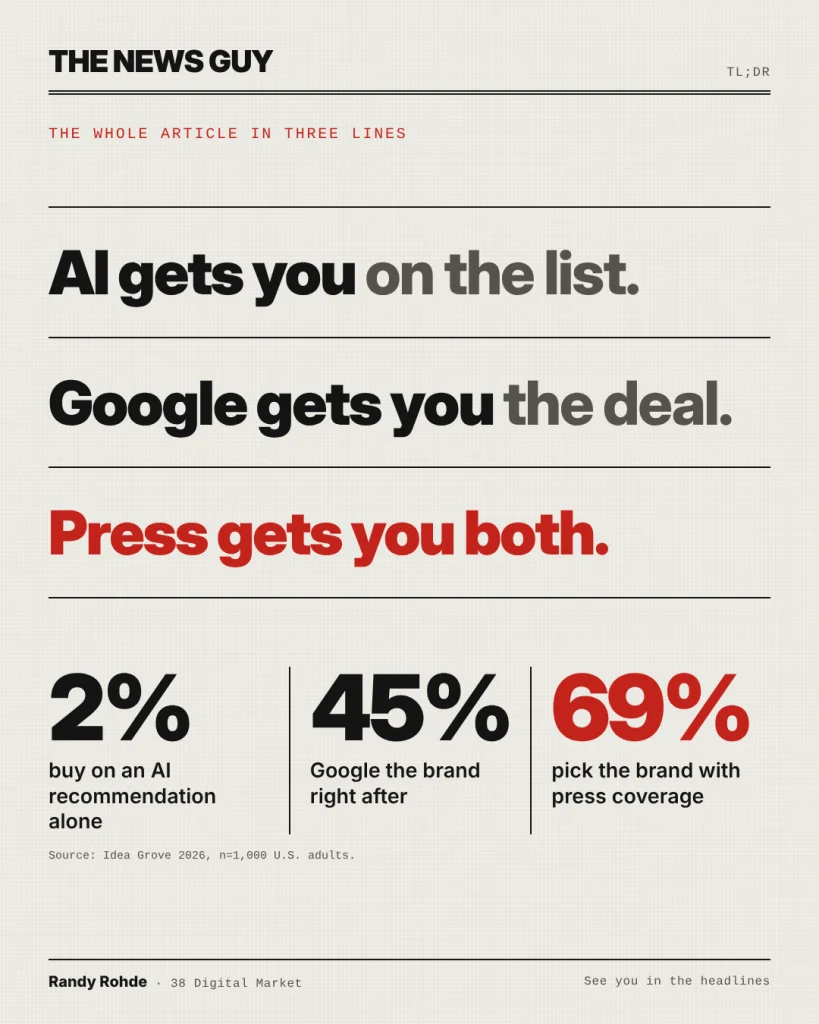
When consumers were asked to choose between two AI-recommended brands, one with media coverage and one without, 69% picked the brand with coverage. Press coverage is one of the few signals a business can create on purpose and on a schedule. You can’t speed up longevity, and you can’t fake reviews (please don’t). You can make news.
What will customers find when they search your business name?
Every brand-name search lands on one of three outcomes. I call it “What Do They Find?”
Door one: the Ghost Town
A website, a Facebook page that hasn’t posted since 2020, and nothing else. The customer’s first thought is “Is this place even open?” The deal is usually dead here.
Door two: the Mixed Bag
Some reviews, a directory listing with an old phone number, and a competitor’s ad sitting on top of your own name. Rude. Also effective. The signals conflict, and the buyer hesitates.
Door three: the Headliner
A current website, strong reviews, and real news coverage with your name in the headline. This is the business that gets the call.
Ready to get Started?
Why does a press release help in both AI answers and Google search?
A press release doesn’t win once. It wins twice.
Win one is the AI answer. AI tools learn about brands from what’s published about them across the web. A well-built press release, distributed to real news sites, gives those systems clear and consistent facts about who you are, what you do, and where you do it. That’s why I call press releases prompt engineering. You’re writing the notes the AI studies before the test.
Win two is the verification search. When customers Google you, those same news articles show up on page one. Instead of a Ghost Town, they see headlines.
One asset, two jobs. Think of it as a mullet: business in the AI answer, party on page one.
How can a business prepare for the verification search?
Use this checklist to move from Ghost Town to Headliner:
- Google yourself today. Search your business name, your own name, and your business name plus “reviews.” That is what the 45% see. Bring a stress ball.
- Fix the basics. Update your Google Business Profile and directory listings so your name, address, phone number, and hours match everywhere.
- Give the press something real. A launch, a milestone, a key hire, an anniversary, or a local partnership. Write a press release that states clearly who you are, what you do, and where you do it.
- Distribute it to recognized news sites. Placement on credible outlets puts your story where both AI systems and human searchers look.
- Back it up. Keep reviews current, keep your website up to date, and publish a founder profile. Press coverage opens the door, and reviews keep it from slamming on your foot.
- Repeat. One release is a headline. A steady stream is a reputation.
AI gets you on the list. Google gets you the deal. Press gets you both.
Frequently asked questions
Do consumers trust AI product recommendations?
Most do not fully trust them. In Idea Grove’s April 2026 survey of 1,000 U.S. adults, only 15% said AI recommendations are generally the best options available. About 40% use AI but don’t fully trust it, 27% are actively skeptical, and 19% don’t trust AI recommendations at all.
What do people do after ChatGPT recommends a brand they don’t know?
Most verify the brand before buying. Idea Grove found that 45% immediately search the brand on Google, 18% go to review sites, 16% visit the brand’s website, and 9% ask someone they know. Only 2% buy based on the AI recommendation alone.
How can a business get recommended by ChatGPT and other AI tools?
AI tools describe businesses using information published about them across the web. A business improves its chances by publishing clear, consistent facts about who it is, what it does, and where it operates, ideally through press releases distributed to recognized news sites, plus accurate listings and current reviews.
Do press releases help with AI visibility?
Yes, when they are well written and distributed to credible news sites. A press release gives AI systems consistent facts to learn from, and the resulting news articles also appear in Google when buyers search the brand. Randy Rohde of The News Guy calls this “press release prompt engineering.”
Why does press coverage increase consumer trust?
Coverage in a recognized publication is third-party validation that the business is real and active. In Idea Grove’s 2026 survey, 58% of consumers said press coverage increases their trust, and 69% would choose a brand with media coverage over an otherwise similar brand without it.
What should business owners check when they Google their own brand?
Search the business name, the owner’s or founder’s name, and the business name plus “reviews.” Check that listings show the current phone number and address, that recent reviews appear, that no competitor ads sit above the brand name, and that at least one recent news article mentions the business.
Find out what AI and Google say about your brand
Want the full playbook? Download the free eBook, How To Get Your Brand Featured in AI Overviews. It’s free. I checked. Twice.
Or book a free 15-minute press release consultation, and we’ll look at what Google and ChatGPT are saying about your brand right now. Bring your questions. I’ll bring the coffee (virtually).
About the author
Randy Rohde is the founder and CEO of 38 Digital Market and The News Guy, a press release distribution and AI visibility firm based in Chagrin Falls, Ohio. A nationally recognized PR expert with a journalism background, Randy helps businesses use press releases for Answer Engine Optimization (AEO), so AI tools and search engines describe them accurately. He hosts the Hot Off The Press podcast and a weekly YouTube series, and serves on the board of the Chagrin Valley Chamber of Commerce. Connect with Randy on LinkedIn or Facebook.
Sources
- Idea Grove, “New Research: Only 2% of Consumers Buy From an AI-Recommended Brand Without Checking It First” (April 15, 2026). Survey of 1,000 U.S. adults conducted via Pollfish, April 2026.
Ready to get Started?
