
Introduction
Publishing a press release gets your announcement into the world, but publication is only the beginning. Once the news is distributed, search engines and AI systems still need enough context to understand who published it, what the announcement is about, and how the information connects to the business behind it.
Modern search is no longer limited to presenting a list of links. AI-powered platforms can retrieve information from multiple sources, connect related entities, and use those relationships when generating answers. A press release can provide an important piece of that information, but a single URL does not always provide the full context surrounding a brand or announcement.
The News Guy applies the Google Entity Stack approach to this idea, using a connected ecosystem of relevant Google properties to give a press release additional context. The strategy creates relationships between the announcement, the brand, and the page the business wants to promote, creating a broader signal package designed to support visibility across search engines and AI-powered search.

Ready to get Started?
Key Takeaways
- A Google Entity Stack connects supporting Google-owned properties to a press release, brand, and priority landing page.
- The strategy can reinforce relationships between a company, its announcement, website, products or services, and relevant locations or dates.
- The press release remains the source of the news, while the Entity Stack provides supporting context around the announcement.
- The strongest stacks are built around a clear business message rather than around every available Google property.
- An Entity Stack does not guarantee rankings, AI citations, or inclusion in Google AI Overviews; it is designed to support a stronger, more connected digital footprint.
What Is a Google Entity Stack?
A Google Entity Stack is a collection of connected Google properties built around a company’s news or announcement. Rather than allowing a press release to exist as a standalone piece of content, the strategy creates supporting assets that reinforce the same company, topic, announcement, and destination.
Those assets can include Google Sites, Blogger, Google My Maps, Calendar, Docs, Slides, PDFs, Drawings, Images, Groups, and Forms. Each property can serve a different purpose, while the connections between them help provide additional information about the same entity and its news.
The goal is not to copy and paste a press release across multiple Google properties. Instead, the supporting ecosystem should provide relevant information around the original announcement, with appropriate assets linking back to the press release, the brand, and a priority landing or conversion page.
Why a Press Release Alone May Not Be Enough
A press release contains many of the signals search engines and AI systems need, including company names, products, locations, dates, quotes, statistics, and other details about the announcement. When the release is properly structured, those details can also become easier for AI systems to retrieve and understand.
Content structure, however, is only one part of the visibility equation.
Modern search increasingly involves AI systems retrieving information and using it to construct direct answers. This creates a broader visibility opportunity for brands because the objective is no longer limited to appearing as a search result; the information itself can become part of an answer generated for a user.
A Google Entity Stack supports this approach by giving the announcement additional context across connected properties, helping reinforce the relationships between the brand, the announcement, and other relevant information.
From One URL to a Connected Signal Package

Consider what happens when a press release is published on its own. It contains the announcement, and distribution can place copies or references to that announcement across external sites, creating useful exposure while leaving the original release as the primary piece of content representing the story.
A Google Entity Stack adds another layer by creating supporting assets around that announcement.
A branded Google Site can provide an overview of the news, while a Blogger post can expand on the story from an editorial perspective. A Google Doc or PDF can contain supporting information, and a Slide presentation can reinforce key details in another format. When relevant, a calendar event can establish an important date, while a map can provide geographic context.
These assets do not need to repeat the same information. Their purpose is to reinforce the same underlying entity and announcement from different, relevant angles, creating a more complete signal package than the press release could provide by itself.
The Google Properties Behind the Stack
The specific properties used can vary depending on the announcement and the information that needs to be reinforced.
Google Sites can provide a branded destination that brings the announcement and supporting information together.
Blogger can provide additional editorial context around the news, giving the announcement another format through which its topic and entities can be understood.
Google My Maps can add geographic context when the announcement involves a specific location, service area, property, event, or market.
Google Calendar can reinforce dates associated with launches, events, deadlines, or other time-sensitive announcements.
Google Docs, Slides, PDFs, and Drawings can provide supporting materials that expand on the information contained in the original release.
Images, Groups, and Forms can add additional supporting assets or engagement elements when they are relevant to the campaign.
The point is not to use every available Google property simply because it exists. A stronger implementation uses the properties that make sense for the story and connects them around a consistent entity and business message.
How the Google Entity Stack Works
The process begins with the press release, which establishes the primary news, including what happened, which company is involved, what product or service is being discussed, and which details matter most. Once that foundation is established, supporting Google properties can be created around the same information.
Each asset can then serve a specific role within the ecosystem. A Google Site might summarize the announcement, a supporting document could provide additional information, a presentation could explain the product or initiative, and a calendar entry could establish the relevant date. When location is important to the announcement, a map can provide another layer of geographic context.
The connections between these assets are also important because relevant properties can link back to the press release, the company, and the priority page the business wants to support. This creates a connected network rather than a collection of unrelated pages.
Why Entity Relationships Matter
Search engines and AI systems need more than individual facts; they also need to understand how those facts relate to one another.
A company name appearing on one page provides useful information, but consistently associating that company with its website, products, locations, announcements, and supporting content provides additional context about the entity being described.
This is the underlying idea behind entity-based search. Rather than treating every page as an isolated document, search systems can connect information that appears to describe the same real-world entity, making it easier to understand what a business is, what it does, and what its announcement represents.
A Google Entity Stack is designed to reinforce those relationships by connecting multiple supporting properties around the same announcement and brand.
The Press Release Still Comes First
The Entity Stack supports the press release by expanding the context surrounding the announcement and reinforcing the information that matters. The original release remains the source of the news, while the supporting properties provide additional information and connections around it.
That also means the quality of the original release still matters. If an announcement is vague, inconsistent, or difficult to understand, adding more supporting pages does not automatically solve the underlying problem. A clear and well-structured release gives the supporting ecosystem a stronger foundation.
For example, the SCAN Framework focuses on structuring press releases around four principles: Structured, Clear Focus, Authoritative Quotes, and Numerical Specificity. The framework’s three data blocks—the Lead Bias Payload, Key Data Cable, and Prompt Mimic FAQ—are designed to make important information easier for AI systems to understand, retrieve, and cite.
The Google Entity Stack approaches the same visibility challenge from a different direction. SCAN focuses on how the information is structured inside the release, while the Entity Stack focuses on the connected ecosystem surrounding that release.
Structure and Amplification Work Together
This distinction becomes important when looking at a complete AI visibility strategy. A press release can be well structured but have little supporting context around the brand, while a business can have a large digital footprint but publish announcements that are difficult for AI systems to interpret.
An AI-friendly press release structure addresses the first part by making the announcement itself easier to parse and retrieve. A Google Entity Stack addresses the next layer by surrounding that announcement with connected supporting assets.
Together, these approaches address both the information contained within the announcement and the broader ecosystem surrounding it.
Distribution Is Not the Same as Amplification
Press release distribution and entity stacking serve different purposes. Distribution focuses on getting the announcement published across media and news channels so that the story can reach journalists, readers, search engines, and other audiences; in other words, it answers the question, where does the news appear?
Entity stacking focuses on what surrounds the announcement after it is published. By adding supporting properties and connections, it reinforces the company, the topic, and the destination associated with the news, answering a different question: what additional context supports the news?
That distinction can be particularly useful for major announcements that a business expects to support visibility beyond the initial publication period.
When Is a Google Entity Stack Most Useful?
Not every announcement requires the same level of supporting infrastructure. A routine company update may not justify building an extensive ecosystem, while a major announcement can benefit from additional assets that continue reinforcing the story.
Product launches are one example. A launch can have a dedicated Google Site, supporting product information, presentation materials, images, a launch date, and other relevant resources that connect back to the original announcement.
Funding announcements can also benefit from additional context around the company, its milestone, and the information associated with the announcement. Reputation campaigns may similarly benefit from a connected collection of assets that reinforce the same brand narrative over time.
The common factor is that the announcement has enough importance to justify creating a longer-lived digital footprint around it.
Building a Longer-Lived Asset
A press release often receives its strongest attention immediately after publication, but its usefulness does not necessarily end with the initial distribution period.
The announcement can continue to be indexed, referenced, discovered through branded searches, and connected to other information about the company. A supporting ecosystem gives the original news additional assets that can remain available after the initial publication period.
This can be particularly valuable when the announcement represents something the business wants associated with its brand for the long term. A product launch can remain relevant after launch week, a funding announcement can continue to represent an important company milestone, and a reputation campaign may require consistent reinforcement rather than a single publication.
The Entity Stack is designed to help turn those announcements into longer-lived signal assets.
What the Google Entity Stack Does for AI Visibility
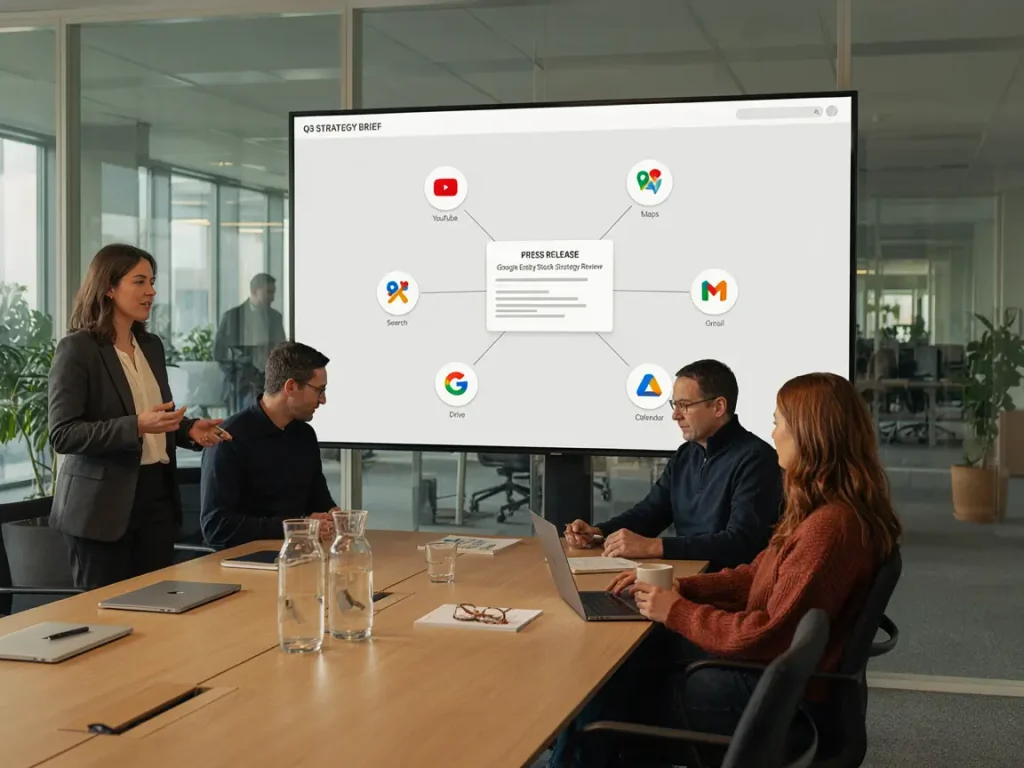
There is no guarantee that a particular Google property will cause a brand to rank or appear in an AI-generated answer. The purpose is more practical: to create a stronger and more connected information environment around the announcement.
AI systems can encounter the company’s name, website, announcement, location, product information, supporting documents, and other related details across multiple connected assets. This provides additional context from which systems can interpret the relationships between those pieces of information.
The same principle applies to traditional search. The objective is not to manufacture rankings, but to create a clearer and more complete digital footprint that supports how search engines and AI systems interpret information about the brand.
From Announcement to Search Asset
A press release gets the news out, while a Google Entity Stack helps make that news part of a broader ecosystem. Instead of allowing the announcement to stand alone as another URL, the strategy connects it with supporting Google-owned properties that reinforce the company, the topic, and the destination that matters to the business.
This makes the approach particularly useful when the goal is not simply to announce something, but to build a stronger and longer-lived digital footprint around the announcement.
The process is straightforward: launch the press release, then build the supporting Google Entity Stack around it. The result is a connected signal package designed to support greater visibility across search and AI.
Building a Stronger Search Signal
A Google Entity Stack can give a press release more context than the announcement itself can provide. By connecting supporting Google properties to the press release, brand, and priority landing page, businesses can create a more complete network of signals that search engines and AI systems can interpret and connect.
The objective is not to publish more content simply to increase the number of URLs associated with a brand. Instead, the goal is to create useful relationships between the announcement and the supporting information around it, making the story easier to understand as part of a broader brand entity.
If you’re building press releases with AI visibility in mind, the next step is understanding how the announcement itself should be structured for retrieval and citation. The SCAN Framework for AI-Friendly Press Releases offers a practical approach to organizing key information, data points, and FAQs so the content is easier for AI systems to understand and use.
You can also explore the other resources in the blog to see how press releases, entity signals, and external authority work together as part of a broader search strategy. For a more personalized look at your current approach, you can schedule a free 15-minute consultation to discuss your goals and identify opportunities to strengthen your search and AI visibility.
Or, if you want to start with a practical resource, download the free guide, How To Get Your Brand Featured in AI Overviews, for additional strategies you can apply to your own content.
Frequently Asked Questions
What is a Google Entity Stack?
A Google Entity Stack is a connected group of Google-owned properties built around a press release, company, product, or major announcement. The assets provide additional context and link relevant information back to the original announcement and priority landing page.
What Google properties can be used in an Entity Stack?
Depending on the campaign, an Entity Stack can include Google Sites, Blogger, My Maps, Calendar, Docs, Slides, PDFs, Drawings, Images, Groups, and Forms. The specific combination should depend on the announcement and the type of information being reinforced.
Does a Google Entity Stack guarantee AI citations?
No. An Entity Stack does not guarantee rankings, AI Overview placements, or citations. Its purpose is to create a more connected information environment that can help search engines and AI systems understand the relationship between the brand, its announcement, and supporting information.
How does an Entity Stack work with a press release?
The press release establishes the main announcement, while the supporting Google properties provide additional context. Relevant assets can link back to the release, the brand website, and a priority landing or conversion page.
Is a Google Entity Stack the same as press release distribution?
No. Distribution focuses on publishing and exposing the announcement through media and news channels, while an Entity Stack focuses on building a connected ecosystem of supporting Google properties around the announcement.
When should a business use a Google Entity Stack?
It can be particularly useful for major announcements such as product launches, funding announcements, reputation campaigns, partnerships, and other news that a business wants to support beyond the initial publication period.